

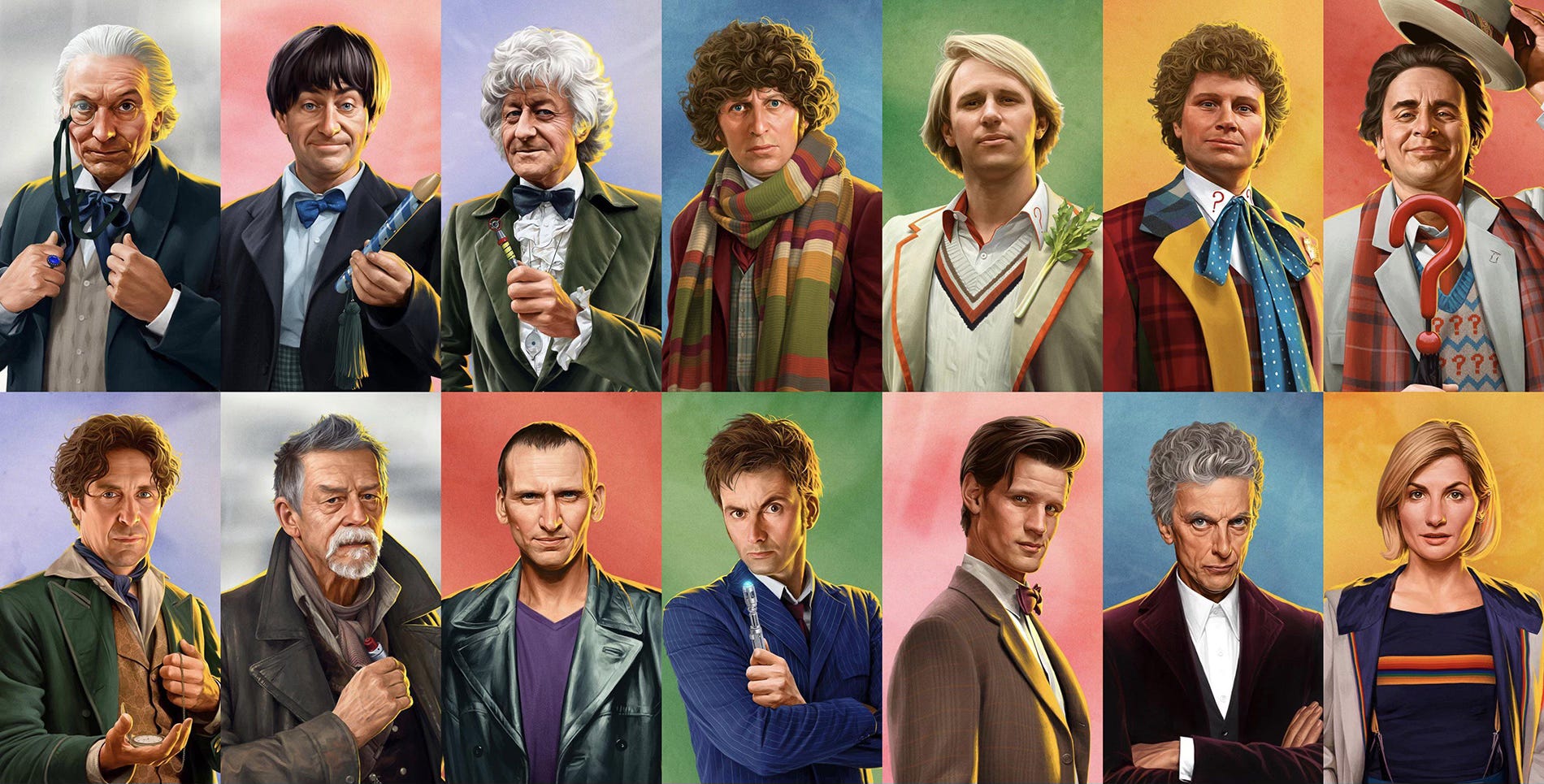
I remember the very first episode of Doctor Who. Very scary. For years from then on, the Doctor provided a Saturday early-evening backing-track to my childhood until — like many people — I began to lose interest in portrayals of the character: McCoy, Baker (the second one, obviously).
Tennant and Smith (especially Smith!) reignited the flame for me until it was gradually extinguished again by Capaldi, Pike — and ‘Hollywood’…. Sadly, as I sit here now, I fail to see how the spark will ever be reignited.
One constant — or inconstant I suppose, depending on how you want to look at it — is the Doctor’s somewhat ‘fluid’ relationship with Time. Perhaps it’s inevitable that, growing up as one of the Doctor’s ‘virtual’ companions, I may have been infected with the notion that, even though it hasn’t been ‘invented’ yet, time travel is ‘a thing’.
As naïve and impossible as it is, when looking back on my past there are incidents — if not regarding them as ‘fixed points in time’ — to which I will be able to return, make difference decisions, effect an alternative outcome.
Time travel and regret: such a potent combination!
In the December 2025 issue of Philosophy Now there’s an interesting article by Tara Daneshmand, ‘The Necessary Ache’, which explores our relationship with pain and regret. In it she cogently argues that these two bedfellows are inevitable and constituent parts of what it means to live:
Pain and regret are not unfortunate byproducts of poor choice, they’re proof that we’ve chosen at all. They’re evidence, not of failure, but of active participation in life — of having dared to care, to desire, to act. They’re the very ground from which meaning grows.
That last sentence is an important one. Our lives are defined by the choices we make, and the consequent life we live with — pain, regret and all — is the outcome:
I believe we have two lives: the life we learn with, and the life we live with after that. — Glenn Close in The Natural
What has all that got to do with time travel, you may ask. Perhaps the desire to be able go back into our past (‘time travel’) and make difference choices — “the road not taken”, Robert Frost — is an inevitability, ingrained in our DNA, partners-in-crime with pain and regret; so much so that when a fiction comes along suggesting it’s actually possible to do so…well, we can be suckers for that kind of fantasy, can’t we? Enter Doctor Who.
But not only is that particular circus trick impossible, it also represents an ‘undoing’ of ourselves; after all, if we could go back and make different choices then we’d become different people:
We shall not cease from exploration
And the end of all our exploring
Will be to arrive where we started
And know the place for the first time.
— ‘Little Gidding’, Four Quartets, T.S.Eliot
Or find ourselves wiped clean perhaps…
So time travel’s impossible, a fiction; we are where we are. Suck it up!
Yet as writers we can time travel. There’s nothing to stop us going back and ‘re-living’ on the page, make different choices, explore alternative outcomes. And we can do so time and again. We create characters who can stand in for us if we want them too; or we can throw the cloak of a myriad of ‘what ifs?’ over them and see what happens.
Isn’t this time travel in a way? And if it is, doesn’t that give us the best of all possible worlds — both real and fantastical?
I think it should.
And yet to do so as successfully as we might, I wonder if we also have to accept Tara Daneshmand’s theory, and embrace pain and regret not only as constituent parts of living, but as the positive proof that we have not lived a passive life.
Now that and writing is a truly powerful combination!