
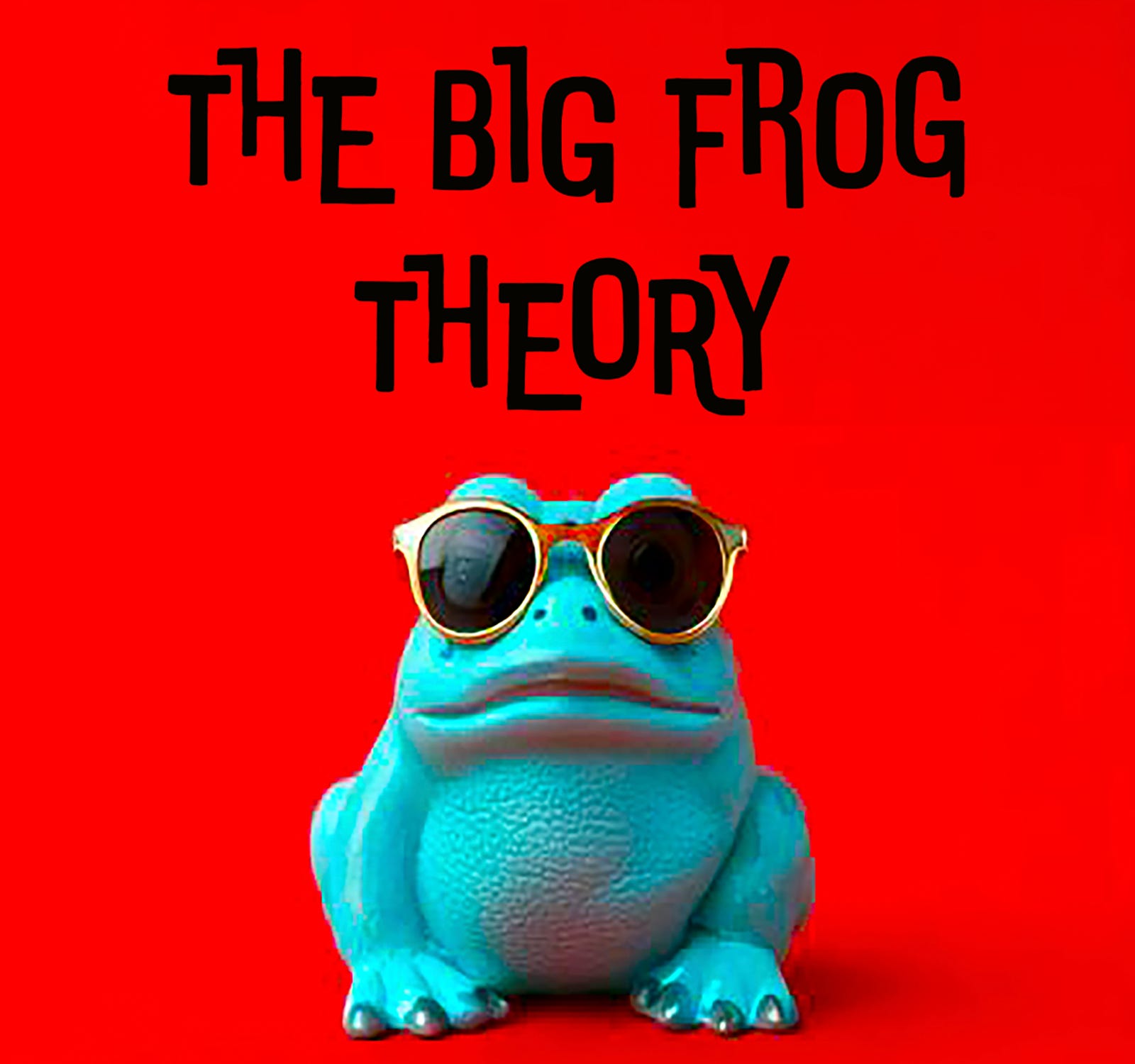
The Big Frog Theory - 8
The weekly serialisation of my Magic Realism novel.
FIFTEEN
Neville opened the menu and was confronted with two pages, listing — in a highly stylised script — the dishes on offer. Unable to resist habit, he scanned the pages for looking for prices but found none. There was also no mention of wines, and Gustav had failed to leave him a wine list. Undeterred — and already slightly relaxed by the gin — he decided to press on with his selection.
The left hand page of the menu summarised the Entrees; the right, the main courses. As he scanned for his starter he was immediately impressed by not only the range of dishes available, but their sophistication. He was not in the mood for fish, nor the more traditional starters such as pate or soup — even though these, as described, encouraged selection. Consequently he expected to find making the final choice difficult, but this proved not to be the case. One dish stood out: Salad of Roast Duck, served on a bed of wild rice; dressed with a light pepper and gherkin salad, and finished with a Cherry and Rose glaze. Thus decided, he turned his attention to the second page.
Over time he had become aware that, in certain circles, there was a kind of etiquette regarding the “construction” of a meal. Starting with duck, for example, would in theory limit the number of dishes available for a main course. But things were not, of course, subject to the “norm” at present (in almost any sense, as far as Neville could see) so he immediately decided to consider all options fair game. In Paris, Neville had seemed to take his food “on the run” as it were, and — to his chagrin — failed to take any advantage of the city’s distinct cuisine. It felt as if he should have been in a similar situation to this whilst there — sitting in a restaurant, choosing a meal — but this had not materialised. On the basis of his entrée, he bypassed the chicken dishes and the fowl; this left him with meat, fish, or vegetarian.
Neville had dabbled with vegetarianism in the past, but unsuccessfully. For him it felt like something he would have to work at rather than instinctively adopt. For this reason, if none other, he was drawn to either the meat or fish. Logic having taken him this far, he took another sip from his gin, and undertook the final selection. As before, the task seemed simpler than he imagined possible; and once again the choice was obvious: Fillet of Monkfish pan-baked in fresh cream, dressed with a subtle dill and thyme sauce, and complemented with nuggets of honey-glazed carrots, buttered mange tout, and lightly dusted mustard potatoes. Satisfied, he closed the menu.
‘Great choice! “On the money”, Bob!’
The voice game from his side, and he turned to find a large, bright blue fish addressing him from the mural.
‘Monkfish; great! They do it so well, it’s “out of this world”.’
The fish had large, bulbous eyes that were slightly out of alignment, giving it a peculiar stare. In addition, the artist — whom, Neville judged, could never profess that painting fish was his strongest suit — had given the creature a strange lop-sided leer. Neville glanced along the rest of the mural. The style throughout was similar, but this fish a shade exceptional. Gustav returned.
‘Sir?’
‘Yes. The duck, followed by the monkfish, please.’
‘Sir.’
‘Is there a wine list?’
‘We are proud to think that we know our wines at this establishment, Sir, and it is our policy to provide our customers with precisely the correct wine for each of their courses. That way, you do not have to worry over the selection, and we ensure you get the best experience. Is that satisfactory, Sir?’
‘Sounds fine. Thank you.’
As Gustav removed both the menu and himself, Neville was left impressed with the restaurant’s efficiency.
‘Really “on the ball”, isn’t it?’ — the fish again — ‘taking all the hassle out of it. And he’s right, Bob; the wine’s exceptional.’
‘I’m sure.’
Neville glanced round the room. All the other diners appeared to be eating and drinking with such an air of satisfaction to suggest that there was some truth in what the fish had said. One well-dressed middle-aged lady glanced across from her table, and gave him a slight smile. She looked vaguely familiar.
‘And yep, “you know your onions”! The duck; wow!’
Neville glanced back at the leery fish, frozen in the mural.
‘It’s exactly what the woman had; duck and monkfish.’
‘Woman?’
‘Yes; the broad who was here before you. The one with the pink dress.’
‘Really?’
The fish lowered his voice.
‘If I’d had been just a few inches further that way Bob, I could have spent the entire meal looking down her cleavage!’
Neville was taken aback. Perhaps that kind of attitude went with the fish’s rather lascivious look.
‘”You bet your boots”, she had a great pair of...’
‘Enough, I think, don’t you?’
‘Sorry, Bob; just “passing the time of day”.’
‘And don’t call me Bob!’
‘”Keep your hair on”, Bob. “Can’t teach an old dog, new tricks”, eh?’
Neville returned the leer with a little contempt, but refused to respond to the fish’s last remark. In addition to the continual reference to “Bob”, he was beginning to be annoyed by the fish’s ruthless use of cliché — even where marginally appropriate. He thought about changing his seat, but recollected that there was unlikely to be an alternative available. Perhaps, if it was in danger of spoiling his meal, they might like to paint out the fish on the wall.
‘Hey, Bob; “horses for courses”. I can’t help being me, can I? How much choice did I get, “hear what I’m saying”? Shoot the artist if you like, but “don’t shoot the messenger”.’
Neville felt vaguely guilty at being hostile, and his desire to obliterate the fish altogether.
‘OK; just be a little quieter, maybe.’
‘Quiet, Bob? “Like the grave”!’
A few moments later, Gustav returned with a trolley on which were Neville’s Entree and a half bottle of red wine. He laid the plate on the table with a slightly extravagant air.
‘Your duck, Sir.’
The food presented looked nothing less than sculpted: slices of duck nestling on their wild rice bed, couched within the pepper and gherkin salad, all on the shoreline of the red cherry dressing. It was — as the fish might have said — “too good to eat”.
‘White is normal for the Entree,’ Gustav said, pouring the wine, ‘but as you were having the duck followed by fish, we felt that this red — a light Beaujolais — would best suit. If Sir would care to taste...’
Neville lifted the wine to his lips. It was smooth, and skipped lightly across his palette.
‘Very pleasant, thank you.’
Gustav nodded and withdrew. For a short while Neville began to delicately dismantle the food on this plate. The duck was immaculate, and the combination offered with it such a stunning mixture of flavours and textures, that his taste buds were thrown into something of a frenzy.
‘A little better than you’re used to, Bob? “Home cooking”, eh?’
‘Yes’, Neville looked at the fish, deciding to be a little nicer to him. ‘And you were right; the food is truly excellent.’
‘The smell gets me every time. Well, the taste can’t, can it?! Turns me “green with envy”’. And is if to prove it, the fish flashed from blue to green, and then back again.
Neville sipped the wine. With the remnants of duck and peppers still on his palate, the Beaujolais tasted better than before.
‘”Compliments to the chef”, eh Bob? That’s exactly what the Broad said. She called Gustav over and said “Compliments to the chef”. People always do.’
‘I don’t blame them. The food is wonderful.’
Gradually the first course disappeared, and it was with some satisfaction that Neville closed the knife and fork on his plate, and poured himself the remainder of the red wine. On cue, Gustav came over to remove the plate.
‘That was excellent,’ Neville hesitated. ‘Compliments to the chef.’
‘Bob!’, the fish said, after Gustav had gone, ‘I knew you’d say that! Didn’t I say they always say that!’
‘Who?’
‘Customers. They are always so impressed; that’s what they say.’
‘Just like they say other things?’
‘Sorry, Bob?’
‘Perhaps “don’t shoot the messenger”; or “can’t teach an old dog new tricks”; “horses for courses”?’
The fish was silent for a moment.
‘OK; yes, like those things. Those are the sorts of things people say, OK? Don’t take the piss out of the way I speak, Bob. How else am I supposed to learn except by listening to others; “leading by example”, “hear what I’m saying?” That’s all there is: “day in, day out”. I listen, I learn. OK? Sure, I’m just some dumb fish, but that’s it.’
‘OK, sorry.’
‘Sorry? Shit, you people, you’ve all got attitudes; “know what I mean?” That broad wasn’t quite as bad as you, but I bet the next guy will be; I can tell Bob, I’ve seen them all.’
Gustav’s arrival with the trolley once again interrupted them. Neville, who had become uncertain as to the direction the conversation with the fish was taking, found himself needing to refocus on food and the principle purpose of the evening. The waiter, having removed the red wine bottle and glass from the table, deposited a chilled bottle of white wine and fresh glass.
‘A Chablis, Sir. I think you will find it quite perfect for the monkfish.’ And then, with an even grander flourish than before, he removed the silver dome from Neville’s plate to reveal the glory of his main course.
The monkfish sat proudly in the centre of the plate, mange tout radiating outwards. In the segments created by the mange tout, the carrots and potatoes alternated, the whole arrangement encircled by the gentleness of the sauce. Neville simply nodded at Gustav, preferring this time to say nothing. He took a sip of the Chablis before picking up his knife and fork. Deciding where to start was not easy, as the very first incursion would disrupt the symmetry of the plate. He chose mange tout, and then everything followed from that. The fish kept a respectable silence for a while as Neville savoured the exquisite meal. It was difficult not to eat at a breakneck pace, and he found himself needing to be disciplined in order to progress at an acceptable speed. The monkfish simply dissolved in his mouth, and each of the accompanying vegetables were cooked to perfection.
Movement across the room attracted his attention as one of the parties stood up to leave. This was the table containing the lady who had smiled briefly earlier on. She was a largish woman with well tonsured hair; the kind of blue-grey perm so favoured by ladies of a certain generation. She glanced at him again as she moved away, and Neville once again had the sensation that he had seen her somewhere before.
‘So it’s OK then, the food?’
Neville would have expected that sort of question to come from the Maitre or Gustav, but it was the fish again.
‘Superb, of course.’
He expected more from the fish but there was no follow up. He looked at the large blue body, the strange eyes and the leer, and felt vaguely sorry for him.
‘What kind of fish are you anyway?’
‘Me? That’s tough. I’ve been “kept in the dark” over that one, Bob, so I’m not sure I can say. Does it matter?’
Neville paused, fork paused before his mouth.
‘No, I guess it doesn’t.’
‘No? That’s good. Hey, thanks.’
And Neville was sure that, had he been able to, the fish would have given him a wink of one of his bulbous eyes. He carried on eating, though there was little left now. Another couple entered the room and took up their places at one of the reserved tables, and another waiter — one Neville had not seen before — made an appearance. He checked his watch. It was nearly nine thirty; obviously they closed quite late here.
‘So where are you off to next, Bob?’
‘Next?’
‘I mean, once you’re out of here. Tomorrow, when the sun shines; what does the day have in store for you?’
Neville finished the last morsel from his plate and poured another glass of Chablis.
‘I don’t know; I guess I hadn’t really thought about it.’
‘See if “something turns up”, maybe?’
‘Maybe.’
Neville thought of Samuel outside in the bus, and wondered if there were plans for tomorrow about which he as yet knew nothing.
‘What’s on the schedule?’
‘Schedule?’
‘Yes. You guys always seem to have plans; “things to do, people to see”. People always talk about their plans — to each other, to Gustav, to me even.’
Gustav came and recaptured the now empty plate.
‘Take that broad who was here before you; she talked to me. She had plans, she said — though from what I could see, there was little left on her list.’
Neville began to wonder about the fish’s interest in the previous occupant of his seat. Perhaps there was a little more to it than lechery.
‘So where was she off to, then?’
He tried to sound as disinterested as possible, but from the tone of his reply the fish must have realised he had Neville hooked.
‘She said something about a Cruise; and another trip abroad, I think — though she wasn’t sure about the order in which she’d do things. Why?’
‘No reason.’
Neville’s concentration was now taken again by Gustav, who had reappeared at his table and — having presented him with some coffee — was beginning to relay it. He showed little interest in Neville.
‘What are you doing?’
‘Laying the table, Sir. For the next customer.’
‘But what about dessert?’
‘I’m sorry Sir.’ Meaning to complain, Neville looked up for the Maître. Gustav left the table and walked away to the hallway.
‘It’s always the same, Bob’, said the fish, attempting to console him, ‘there’s never enough time.’
‘What?’
Gustav appeared through the door, accompanied by a large, fat man. They approached Neville’s table. Gustav bowed, slightly.
‘Pardon, Monsieur; but this gentleman has arrived for his booking. I wonder if you would mind if he sat with you for an aperitif while you finish your coffee?’
Neville looked hard at Gustav. Those had been the very words he had used to the woman when he himself had arrived at the table. For a moment he felt a degree of panic, of uncertainty over what exactly was going on; and then, in an instant, the fog cleared. He looked from Gustav to the new arrival.
‘Of course not. I won’t be very long. That is, if the gentleman doesn’t mind.’ He offered a smile to the newcomer, who nodded.
‘See what I mean, Bob?’ whispered the fish.
‘Drink, Sir?’, said Gustav to the man.
‘Beer, ta.’
Neville smiled to himself. They were all in the same boat; him, the woman, this new chap. He could spill the beans now if he choose; let the big man know what was in store for him — even down to the leery-eyed fish — but that would not be playing the game. Hadn’t the woman toyed with the idea of recommending her own choice of meal, but not done so? Had he not chosen it anyway? He looked at the suit the newcomer was wearing. Although he was a very large man, the suit managed to make the best of what was there. In doing so, Neville recognised the handiwork of a certain A. Bossiman. With this, there came a flash of memory, and Neville suddenly knew where he had previously seen the woman’s pink dress.SIXTEEN
Neville spent a short while attempting to establish some kind of rapport between himself and the newcomer. The fat man was, however, ill-disposed to his efforts, possessing a level of taciturnity which blocked all attempts at social chit-chat. Neville wondered if he was facing another of those who had chosen Option 3; and guessed — perhaps rather unkindly — that if he had, this particular adventurer was surely destined for ‘3B’. He felt suddenly sorry for the big man because of this; yet things were never certain, and he could well be wrong. Who was to say how his experience might turn out?
He glanced at the fish. Judging by first appearances (which he knew to be an unwise move) he felt certain that the fish’s words regarding the “next guy’s attitude” were likely to be correct. As he left the restaurant, he wondered how ‘new’ the large man was to the particular game in which they were both engaged. How would he react to the fish, or at ten thirty, when the next customer would presumably arrive at Gustav’s elbow and be invited to share the table for a short while? For his own part, Neville felt he had tried to vary the script a little, perhaps to put a modicum of his own personality into the game in an attempt to make what was to follow a little easier for the subsequent diner. Perhaps? For all he knew, the woman — in that pink ball gown from Mister Bossiman’s — might have been doing exactly the same thing to him.
Samuel was sitting on his bed reading when Neville boarded the bus. The lighting had been changed and was a degree more practical. Samuel looked up, then placed his book — still open — face down on the bedside cabinet.
‘How was your meal, Sir?’
There was a hopeful tone in Samuel’s voice, rather than the air of certainty Neville had convinced himself he would find. He wondered how best to respond. He pulled off his tie as he thought of a reply.
‘The food was excellent, of course.’
‘Good; I was confident it would be. Perhaps you would like a little night-cap before retiring, Sir. I have a little brandy in the galley.’
‘That would be good — and please have one yourself, Samuel.’
Samuel smiled.
‘Thank you Sir, I think I might.’
By the time Samuel returned with the two glasses of brandy, Neville was sitting on his bed in his dressing gown. The suit hung over the door of the cupboard, and Samuel’s first move was towards this.
‘Samuel, please sit down.’
‘I thought I might put this away first, Sir.’
‘It can wait; please.’
Samuel responded by depositing himself in the driver’s seat which he swivelled round to face into the bus. He read Neville’s surprise.
‘Oh, just another little modification I made while you were out, Sir.’
‘You are a very ingenious man, Samuel.’
‘Thank you, Sir. I like to think I can turn my hand to most things.’
‘I hope you are not also ingenuous.’
‘Sir?’
Neville sipped his brandy and felt its warmth contrast the chilled Chablis he had so recently sampled. He was uncertain how to progress this conversation. There were many questions he wanted to ask; things that needed clearing up. He had his own theories too, and was looking for some form of confirmation. As he looked at Samuel, he wondered just how much the latter was in control — or knew, come to that. And how much he was still master of his own destiny.
‘Samuel, I have a feeling that this evening I met two other people who are in the same situation as myself.’
‘”Situation”, Sir?’
‘People who have chosen Option 3. You see?’
‘Indeed.’
‘And...’
‘And?’ Samuel offered a slight frown, suggesting clarification was needed.
‘Is that possible?’
Samuel paused. His eyes remain fixed on Neville’s as he too sipped his brandy. The earlier image Neville had conjured equating Samuel to his grandfather was back again and, because of this, he felt no sense of peril in the conversation to come. Neville pulled his legs up onto the bed, and crossed them beneath him.
‘Yes, it is possible. There are, of course, many people who may — at one time or another — find themselves in a similar situation to yourself. I think you might be surprised to find it is remarkably common.’
‘And do you know them all?’
‘Know them, Sir? No. Some perhaps, over time; but how can I know them all when I am with you?’
‘OK; what about the restaurant then? How come there were at least three of us in there this evening, sitting at the same table, eating the same food?’
‘You are certain of that?’
‘Yes.’
Samuel tipped his glass, and took a little more of the Brandy. He looked hard at Neville.
‘What if I told you that I was not aware of that being the case? Would you suspect me of not telling the truth?’
‘If you were in my shoes...?’
‘Yes,’ Samuel smiled, ‘point taken.’
Neville finished his glass and placed it on the cupboard. Almost before his hand had left it, ruby brown liquid had filled it again. He looked at Samuel.
‘Mere trickery; it is not important. Really.’
Neville nodded, prepared to let it go.
‘The restaurant,’ he pursued, ‘you use it a lot, I assume.’
‘Yes,’ Samuel nodded.
‘Because of the fish?’
‘The fish? Well, I hear that the fish is good there, but then the whole menu is supposed to be excellent.’
‘Samuel, that’s not what I meant — and you probably know it!’
‘I’m not sure I follow, Sir. If our clients decided — as you did — that they want to experience a high quality meal, then this is one of the restaurants we can suggest to them. That is all.’
‘So it has nothing to do with what happened to me inside?’
‘What happens to you inside is — to be blunt — entirely of your own making. What happened to you in Paris was also entirely of your own doing.’
‘OK, let’s forget Paris for a moment. In there,’ Neville nodded his head to indicate the restaurant, ‘I met — Bob. Bob told me that the lady who had been sitting at my table before me — and who I met — had ordered exactly the same food as me, was planning to do exactly the same sorts of things I was planning to do… There’s too much coincidence.’
‘I see.’ Samuel paused. Outside all was quiet, the silence only broken by their conversation. ‘”Bob” told you this, did he? And did you believe him? Was he telling you the truth, and about something that actually happened?’
Neville could not answer.
‘You assume so, yes? But you cannot know, Sir. Perhaps you wanted Bob to tell you these things.’
‘So what about her dress?’
‘Her dress? Whose dress?’
‘The lady at my table. Her dress. It was a flamingo pink ball gown; I saw the same dress at Mister Bossiman’s.’
‘Are you sure?’
‘Positive.’
‘It is true that, like the restaurant, we make full use of Mister Bossiman’s services; but I think you may be overlooking one thing?’
‘Yes?’
‘Mister Bossiman is a gentleman’s tailor. He has nothing to do with ladies’ garments.’
Neville wanted to tell Samuel about the dance he had witnessed, about the dress, the band. But he realised quickly enough that he might be on uncertain ground. If Samuel was right — and why should he not be? — and everything that happened to him was actually within his control, then why should Samuel know about these things? What influence could he have over them? He thought back to Paris, and to Pierre. He had assumed that Pierre was something out of his control — something with a degree of power over him. If Samuel was being completely frank with him, then this might not be the case. Pierre might actually have been a manifestation of some part of himself.
This was difficult. Neville took a large swig from his brandy, and allowed it to burn slowly down the back of his throat. All the while Samuel was looking unswervingly at him.
‘I’m not sure I understand, Samuel.’
There was a note in Neville’s voice that caused the smile to leave Samuel’s face.
‘Please don’t think that you are — how shall I say it? — going mad, Sir. You are not. Really.’ He paused, then with a small note of relief, said ‘Mrs Morris.’
‘Sorry?’
‘Mrs Morris. I saw her leave the restaurant while you were there. Do you remember her?’
Neville tried to regroup his thoughts.
‘Largish, well-dressed lady. With silvery hair?’
‘Indeed. Did you recognise her?’
‘Vaguely, yes.’
‘She was in the tea shop the day we met.’
‘The Conservative Lady.’
‘Sorry, Sir?’
‘Yes, Samuel, I do remember her.’
‘I see her about from time to time. She’s a pleasant enough character, don’t you think?’
Neville nodded. He was uncertain where he should place Mrs Morris in the general scheme of things. Perhaps it was enough for now that she was there in the restaurant and that he recognised her. As he sat pondering, he could almost feel night descending about the bus. Samuel, for the first time in a while, took his eyes from Neville and concentrated on finishing his drink. There was a sense of an averted crisis in the air; that the reality of Mrs Morris, both in Samuel’s world and his own, had anchored him somehow.
‘As a matter of interest, Sir, have you consulted your watch lately?’
Neville looked to his wrist, but the watch had already been put away in the cupboard.
‘No, I haven’t to be honest.’
‘And did you while you were in Paris?’
‘I can only recall looking at it once I was back on the bus; why?’
‘Do you not think it strange, Sir, that given your reasoning that your original situation arose because of money, you should be so unconcerned with how you are spending it now?’
‘But you said that it had nothing to do with value, and was all about worth.’
‘Indeed; but you still have a finite stock with which to play. And yet you seem unconcerned about it.’
‘Is that wrong?’
Samuel smiled again.
‘No, Sir; I am not saying it is wrong, I am just trying to understand your apparently more relaxed attitude.’
‘Perhaps it doesn’t seem so important any more. Perhaps there are other things that matter. Maybe, I was wrong…’
Samuel’s smile broadened.
‘That it’s not money that is the problem — and never was?’ Samuel followed up.
‘That perhaps it got in the way. Or the lack of it got in the way. Yet maybe that wasn’t the case after all.’
He wanted to go to his cupboard and check his watch. He wondered about the worth of his dinner, or of the brandy they were drinking now — or even the “worth” of this present conversation with Samuel. He guessed it might be expensive. A thought crossed his mind.
‘If I am right, Samuel…’
‘Sir?’
‘Do the rules change? Does money become irrelevant?’
Samuel shook his head.
‘I’m afraid not, Sir. The rules cannot change. You made your bargain with Hans, and that is the bargain to which you must adhere. Your search — for whatever it is you are looking, or whatever it is you need — has been underway for a little while. Perhaps only now are you beginning to realise just how things stand. Or how you stand. But, you have defined your limit; you cannot dishonour that.’
‘Cannot?’
‘Cannot.’
Finishing the remnants of his brandy, Neville nodded slowly. He was now quite tired — and, to be truthful, a little drunk. Their conversation had given him much to think about. Despite what Samuel said, it was like throwing away the rules of a game and being given a new set for the same game. Perhaps he had a new goal to consider. Perhaps he had never had a real goal at all. As he slipped out of his dressing gown and into bed, he wondered how much clearer things would be in the morning.