
"Punctuations from History"
A final dance around the maypole of reviewing old poetry collections.
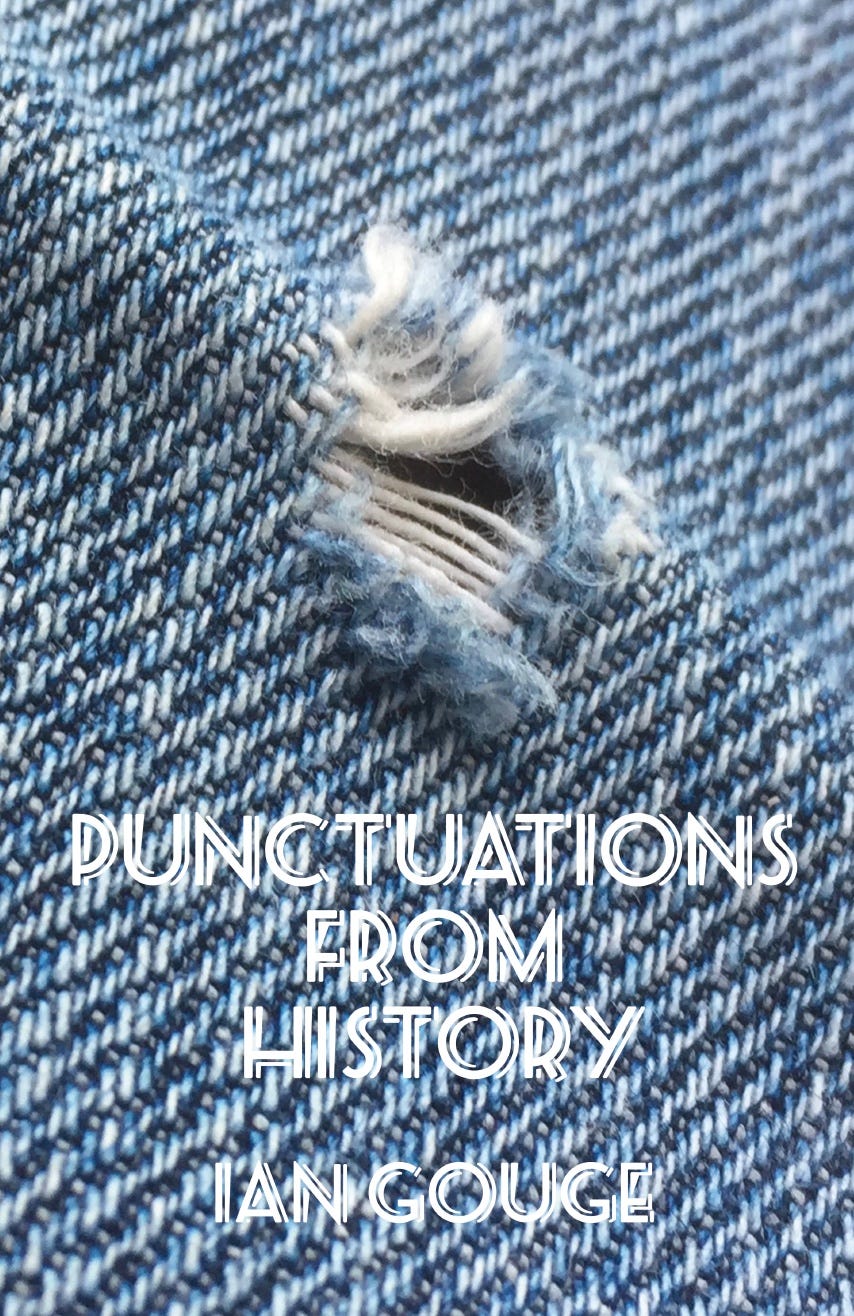
Published in 2018, Punctuations from History was my second poetry collection. Given I have recently reviewed and given minor tweaks to the majority of my earlier work, it seemed only right that I should also tackle this volume. Having said that, I started the exercise with a degree of trepidation; after all, I found some of my debut collection, Human Archaeology, difficult to parse even for me! Would Punctuations — still with a partial leaning towards ‘found’ work — prove equally problematic?
To an extent, yes — but at least accessibility was something I’d recognised at the time and tried to head-off in the foreword to the collection:
People respond better to poems that are immediately accessible. … You can ‘get’ them quicker; there doesn’t appear to be too much buried under the surface... They are ‘easier’; the investment they ask of the reader is not extortionate.
Well then — though don’t ask me exactly how much of that I believe these days!.
On reflection, I think Punctuations does offer more accessible work; not only that, it demonstrates (if one is to look back to it from the uplands of today) just how far my style has changed over the years. Style, yes, but the major preoccupations remain: the nature of history; how we navigate through our own lives; the breadth and depth of the questions about existence we can never hope to answer.
There is also something of the experimental in the collection (I’m thinking of ‘Masks’, ‘Sounds of the House’, and ‘Punctuations from History’ itself). Conventional wisdom seems to suggest that one is more prepared to take risks and break rules when younger, when just setting out, when trying to discover how things — both writing and ‘the World’ — actually work. Maybe that’s true. Maybe we lose that instinct for adventure as our wisdom grows or as we become more comfortable in ourselves, settled into our ‘voice’. If so, the wisdom / lack-of-adventure trade-off sounds vaguely paradoxical, don’t you think?
Anyway, here are three pieces from Punctuations from History.
The Light of Our Lives

We have a jar in our bedroom
where we keep the fragment
that fell from the sky and
buried itself in our garden the day
we moved into our new house.
Some days the meteor would glow
and the jar illuminate
with an impossible light,
and if we removed the lid
the light escaped and our world
and our lives became
just a little more wonderful.
We were blessed when it landed.

But recently the glow is more reticent,
our rock is alive less frequently;
and so it has become harder to top-up
our lives from this astral gift
and we are forced to carry on
as if it never arrived,
as if we were just like other people.
Each evening before bed
I check the jar, ever-hoping,
wishing once again to be able to let
a fraction of the brilliance escape.
But it is always dark these days
and when the lights are off
our bedroom is as black as the sky.Autumn
The church bells were ringing
their Evensong peel
yet how could you hear them
an invisible wind stealing
the sound away and sending it
cascading across the open fields
like a broken promise?The Pennines - Early Winter
The dusted snow lay as if a Breughel
(Elder or Younger) had breezed by,
brush and titanium white in hand,
and treated the landscape to a wash of their talents.
Tufts of rough moor grass poked their fibrous heads
into the stiff northern wind,
clumps of brown punctuating the mucky white
as if the land had hosted some migratory flock
which had invisibly done its business
then moved on elsewhere.
The watery light made the snow retreat a little,
its battle with the bitter wind
adjudicated to a draw.
No doubt they will go at it again tomorrow
though the snow (by Breughel or not)
may mount another raid under darkness’ covers.
There is a balance between the elements even so,
as if the hills, the frozen fronds,
the black-dark clumps of northern pine
have discovered an accord,
a settlement negotiated elsewhere,
a treaty of simple clauses allowing for all eventualities
and rendering the actions of man laughably irrelevant.
Across the field, a dry stone wall
begs repair, as if in those fallen stones
a barrier has been breached and consequence threatened.
But it is illusion. The scrub, the snow, the rocks,
the incessant trilling of the stream still holds sway,
a panoply over which not even
the oldest Master can exert their influence.The earlier reviews:


If any of my books meant something to you, an honest review on Amazon helps other readers find it. It takes about two minutes, and it makes a real difference for an independent author. You can find the book on Amazon via my author page and go from there:
If you enjoyed this article, please ‘like’ or ‘share’ - your validation is really important to me. It’s writing’s lifeblood.