

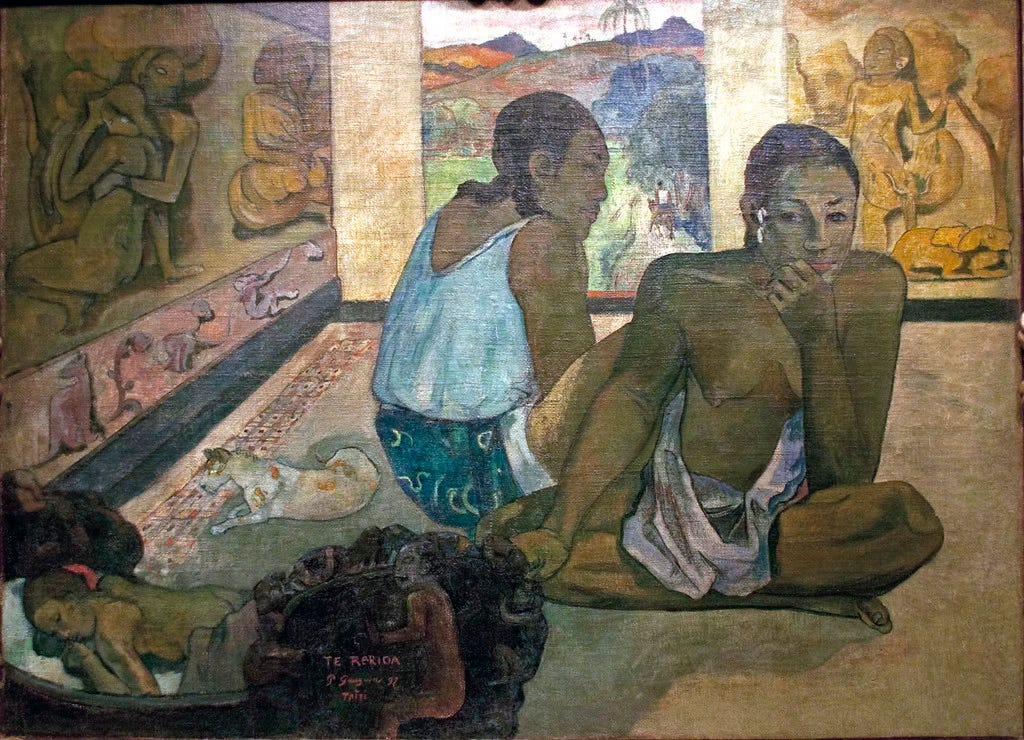
Following on from my visit to London in the Autumn, I have been using some of the paintings I saw at the Courtauld, National Gallery and elsewhere as ‘prompts’ for short pieces of fiction. The story below has been inspired by Paul Gauguin’s The Dream. [Please note: it is not intended to represent an exact descriptive replica of the image.]
In starting to build up a number of these pieces, I am hoping they will turn into a collection later in the year.
Like raindrops dripping from a leaf
When it is still like this you can be forgiven for perceiving an absence of sound. Untroubled by the slightest breath of wind, through the open doorway Mia and Sara could see — away across the fields — the distant ocean, and, coming from there like a heartbeat, the feint sounds of waves caressing the shore. But only if they chose to, for they are not looking in that direction. Almost back-to-back, Mia is staring at the blank wall opposite the open vista, Sara fixed on some other spot between the two. If they were to concentrate, they might also make out the buzz of an insect, or something rustling in the powdered earth layering the cavity beneath the house; and certainly they should hear even more clearly the shallow breathing coming from the small child cocooned in the crib in the corner of the room nearest Mia. Yet they do not look that way, even if they recently had. Perhaps they both watched the child slip into sleep, and — its breathing ever slower — allowed that rhythm to cancel out everything: external sounds, each other, even the child itself. So engrossed are they in their private thoughts they might as well be in the room alone. In some respects they are.
It is not that the general situation is new. The stillness — and under this oppressive heat too! — is common enough, usually presaging rain; and the shack itself, perched on a small incline at the very edge of the village, is infrequently given over to noise. When there is activity such as cooking or cleaning, yes; or when the child is crying because it is hungry or teething. These are episodes which not unnaturally puncture the day. But as the light begins to fade, as all three of them weary, then stillness and quiet descend again; and when the last of the light is almost gone, Sara will rise soundlessly and leave to go home, and Mia will glance at her daughter then prepare her own bed.
Yet there is something else in the air this evening, a novelty preoccupying them to the exclusion of everything else. Sara, dressed in a loose singlet and shorts, surreptitiously glances at her sister now and again, her eyes resting for a moment on the broad expanse of Mia’s back, a back completely exposed since she removed her t-shirt to feed the child over an hour ago. Dark and slightly mottled, if you glanced at it quickly you could be forgiven for thinking it was the back of a young man. Always the more robust of the two — as well as the eldest — Mia exudes a kind of calm strength; and although Sara is, at times, jealous of her sister’s physical presence, she remains grateful that she is the smaller and more slight of the two. The more feminine. And what are they thinking now, these two sisters, as they stare at alternate walls and fail to notice sounds, the fading light? It is as if they have been subsumed in the stillness, become part of it; as if, were they to move suddenly, the whole fabric of the hut, their world — even their own selves — might shatter into a million pieces. Could Mia be blamed for secretly wishing such an outcome?
“Have you heard the rumour?” Sara had asked just as Mia was laying the child to sleep.
“Rumour? What rumour’s that?”
“About Charles.”
Mia froze for a moment — just long enough for Sara to notice — then finished lightly tucking-in her daughter. She rocked back onto her haunches, her powerful thigh muscles suddenly impeccably defined. “Go on.”
“Someone told me he was leaving. Going away to the mainland.”
“That’s no rumour.”
“How long have you known?”
It would have been legitimate for Mia to ask her sister the same question, but she did not. “Since he told me.”
“Yesterday?”
“Today. This afternoon.”
Sara nodded then glanced out of the door, trying to imagine the mainland beyond the horizon. Although she had never ventured that far, she’d heard stories from those who had, tales of the weird and wonderful. Their island was small and primitive in comparison, their lives simple. What would Charles make of it there — or make of himself?
“Did he tell you why he was going?”
Mia looked at her sister then moved to sit cross-legged, thought about putting her t-shirt back on but left it resting in her lap. “What do they always say, these men? Work, opportunity, money.”
“Charles isn’t a stupid man.”
“Of course not.” How could he be, Mia wondered; or how could she think so given he was the father of her child? “But he knows someone there who has made him a promise, and so he must go; and in going, he has made me a promise too.”
“To do what? Come back?”
“To send money, things for the child.” Mia paused. “Men’s promises; they cascade like raindrops dripping from a leaf.” She settled herself at right angles to her sister in order to watch the baby for any tell-tale signs of restlessness.
“No other reason?” Sara’s voice came from over her shoulder.
“Should there be?”
And now there they sit, together but somehow apart. Mia knows Charles has a reputation; theirs is a compact island after all, small enough for all of the men to have a reputation of one sort or another. And some of the women too. It has long been the way of things that capable and ambitious men leave the island when they are in their late teens or early twenties, persuaded to the mainland by the need to escape — or lured there by thoughts of glory. A few have succeeded even if that success was achieved at a modest level. A mere sliver of those have made it to legend. Charles will do well enough, Mia thinks, but he has insufficient talent to lead him to greatness.
Often the men return to the island after a few years, some worn and broken. Most are failures of one sort or another. The result of all this coming and going is that distribution of the island’s male population is skewed: top- and bottom-heavy, a scarcity of good specimens in their middle years. And the women? Although she has said nothing, Mia can see Sara as being the type to make that same journey. She is pretty enough, lively enough; she can be wilful, even reckless at times. Usually those who make the same trek as the men never come back. Legend being an impossibility for them, they fade into obscurity. Or worse. Mia fears for her sister, worried she will make the same mistake as many have before.
And what does Sara think? Or what does she know?
Charles told her of his decision the previous day, ahead of Mia and just twenty-four hours after she had given him her own news. If she had been surprised that his resolution seemed so sudden, the fact that he had arrived at such a position did not; after all, his continuing to live on the island would eventually become untenable. Probably as soon as she started to show. Having made promises to her too, news of what he had told Mia merely confirmed what she had dreaded — not thought, but dreaded. What was it Mia said about promises? Sara has watched water running off the leaves of the trees often enough to know what she meant.
But Sara thinks she is different. As much as she loves Mia, when she looks at her sister she sees someone whose island roots are buried deep. Yes, this is in part due to their shared heritage, but it is also a reflection on Mia herself. To Sara’s mind she is devoid of ambition, and in her solidity what would Mia be able to offer anyone on the mainland? But she is not like that. Is she not younger, full of life? Doesn’t her prettiness and relative youth count for something? Although she has not told Charles this — nor does she know how she will break the news to Mia — Sara has already decided she will follow him. She will wait a few days, get her things together, then go. It would be imprudent to wait too long; if her news broke while still on the island then she would inevitably be compromised. She fears being tied to the place, to her sister, to their children.
So the sisters sit. One stares at the blank wall as if it represents her future, a symbol of her abandonment by the man who — for a short period of time at least — gave her life purpose. The other tries to project herself through the wall at which she looks, imagining what lays beyond it: the ocean, a city, another life.
In the corner of the room the baby sleeps on, blissfully unaware as to the nature of the world into which she has been born, and innocent of the decisions which will undoubtedly await her a few years hence.
Neat, tells the story in the painting without trying to foresee the ending.
I love ekphrastics!