

Were I to write a memoir I suspect I would navigate via other people. People and places. Would that make the book less about me and more a story about others and some kind of loose ‘travelogue’? Or is that not only how we re-tell our stories, but how we live our lives too; lives defined more by attachment than action? I think in many ways it may be.
Which, if so, provokes a further question: what responsibility do we have to those about whom we write? Presumably there’s a responsibility to be accurate (or as accurate as memory allows) and the imperative to be honest, always walking the tightrope between fact and mis-remembered fiction; and would we choose to put ourselves through such trauma — both of memory and of writing — knowing that those concerned (especially from our most recent past) might one day read what we’ve written? One assumes they may be less focussed on us and more on themselves. Indeed, they will judge the accuracy of our story by navigating according to their own versions of events. Under such circumstances, perhaps in our story they become the stars.
Aged six or so we moved back to Portsmouth (the south coast city where I was born) to live with my newly widowed grandmother in Cleveland Road, Fratton. For some three or four years prior to that we had lived in a pre-fab just north of the city.
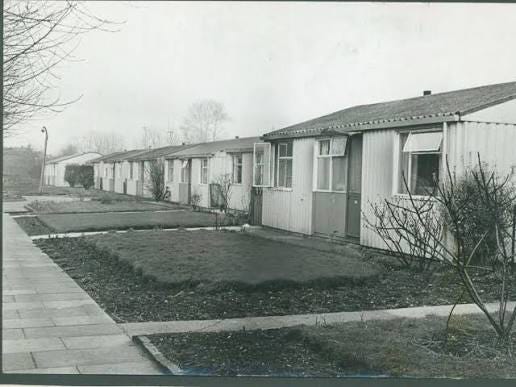
Built in the aftermath of the war, these were awful places probably filled with asbestos: hot in the summer and cold in the winter; walls so hard you couldn’t drive a nail into them. Not too many years later we were to return to another pre-fab for a short while, this time in Gosport across the other side of the harbour. It was one of the fourteen or so stops in ten years of nomadic domestic wandering.
Cleveland Road was a terrace of small three-bed houses whose front door opened straight onto the street. My nan bought the house off-plan for something like £6000. It was never intended we live there, but when my grandad died I suppose the move seemed a logical one. We stayed in the house until a little while after she died and then in 1968 were forced to leave by two of my aunts (who wanted the money from gran’s house sale) and moved across the harbour to Gosport.
For those four years, I attended Somers Road Junior School. Those were the days when parents were happy to let their six-year-old children walk to school on their own — and Cleveland Road to school wasn’t a simple or safe walk!


And the relevance of all this context? A way of introducing Grace, Lisa and Terry. Yes, there were obviously ‘events’ in my life up to that point, but in terms of the real emotional narrative, the nuts-and-bolts of people who were 100% attached to me alone (not gifted via my parents or our extended family) Grace, Lisa and Terry are the triumvirate I always come back to. They were my first people.
Think of the young Elizabeth Taylor in ‘National Velvet’; this is how I choose to recall Grace Campbell: dark, slightly curly hair; slim; very pretty. A group of us occasionally played ‘kiss chase’ in the playground; the boys chasing the girls with the prize for a ‘catch’ being a peck on the cheek. To be honest, I think the group engaged in the practice was pretty small in number — but I’m also certain that at least 50% of the time I chased Grace. One day, overflowing with what I probably imagined was love, I decided to get Grace a present. To facilitate this I told my mum it was her birthday, so that lunchtime we went to the Post Office on Fawcett Road where I bought a do-it-yourself necklace and bangle kit. On reflection it would have been horrendous: cheap and plastic! My mum made me wrap it in paper — and then insisted she come with me to deliver it to Grace! (she may have lived on either Britannia Road North or Victoria Road North, see above). It was a statement of affection and probably my first romantic gesture…
In comparison, Lisa Crook was entirely different in terms of how she looked. I see her now as marginally less ‘girlie’ but with undoubted magnetism nonetheless. Lisa played ‘kiss chase’ too — and was another of my favourites. If it was possible to be doubly besotted then I’d be guilty as charged. I know what you’re thinking, around seven years old and I was already something of a lady-killer! Or worse…
In those days much of our education was rote-learned — and we were tested constantly. We used to have tests every Friday (sums and spelling) and the score you achieved dictated where you sat the following week: the brightest at the tables front left, fading away to those in the dark back right corner. Also there were tests — and prizes (usually a book) — at the end of every year. Terry Walker and I always used to come first and second in those annual tests; one year I’d come out on top, the next year he might. (There was a lad who consistently came third, but I’ve lost his name.) The whole thing was a regime which, in addition to knowledge, instilled competitiveness and aspiration — and, I suspect, a little intellectual snobbery which (if I’m honest) I still carry with me today.
Whichever way you look at it — and leaving family and ‘events’ to one side — Grace, Lisa and Terry were critical to a child growing up in what would soon enough prove to be horrendously difficult circumstances. They were the first emotional attachments I’d chosen for myself. Is that choosing one of the ways of telling we’re becoming our own person? Whether or not I’ve remembered them correctly, I know my gratitude to them is well-placed.
So to finish, a poem. I often used to feign sickness to skive off school. My mum and dad were never hard on me, so it was easily done. I think she liked having me around for company. As an only child, my ‘at home’ days were usually spent in my own world (I started writing stories when I was five) — and the library at Elm Grove was one of my favourite haunts…
Elm Grove Library

it sat back from the road      apologetically
barricaded by modest gardens and a low wall
a municipal bungalow
	the antithesis of splendour and promise

yet inside was a treasure trove
the spot the ‘X’ marked
yards of books on low-slung shelves
	child-high      alluring

feigning illness to bunk-off school again
the boy took possession
imagining a moat around ‘A’ to ‘D’
then drawbridge up
honed-in on Blyton
		famous
			secret

what seeds were sown then
not those of adventure
but saplings of a different kind
	of imagination
		of invention
of the power of putting one word in front of another
and seeing where they took you
‘Elm Grove Library’ is published in The Homelessness of a Child.
If you enjoyed this article, please ‘like’ or ‘share’ - your validation is really important to me. It’s writing’s lifeblood.
Touching evocation of childhood in a more innocent age.